February 20, 2026 · Vyanika Team
How a Pressure-Sensing Mat Calls a Line, Without a Camera
There’s a small family of materials that do a genuinely useful job for a boundary call: they change electrical resistance when you squeeze them.
A pressure-sensitive film, not a sensor chip
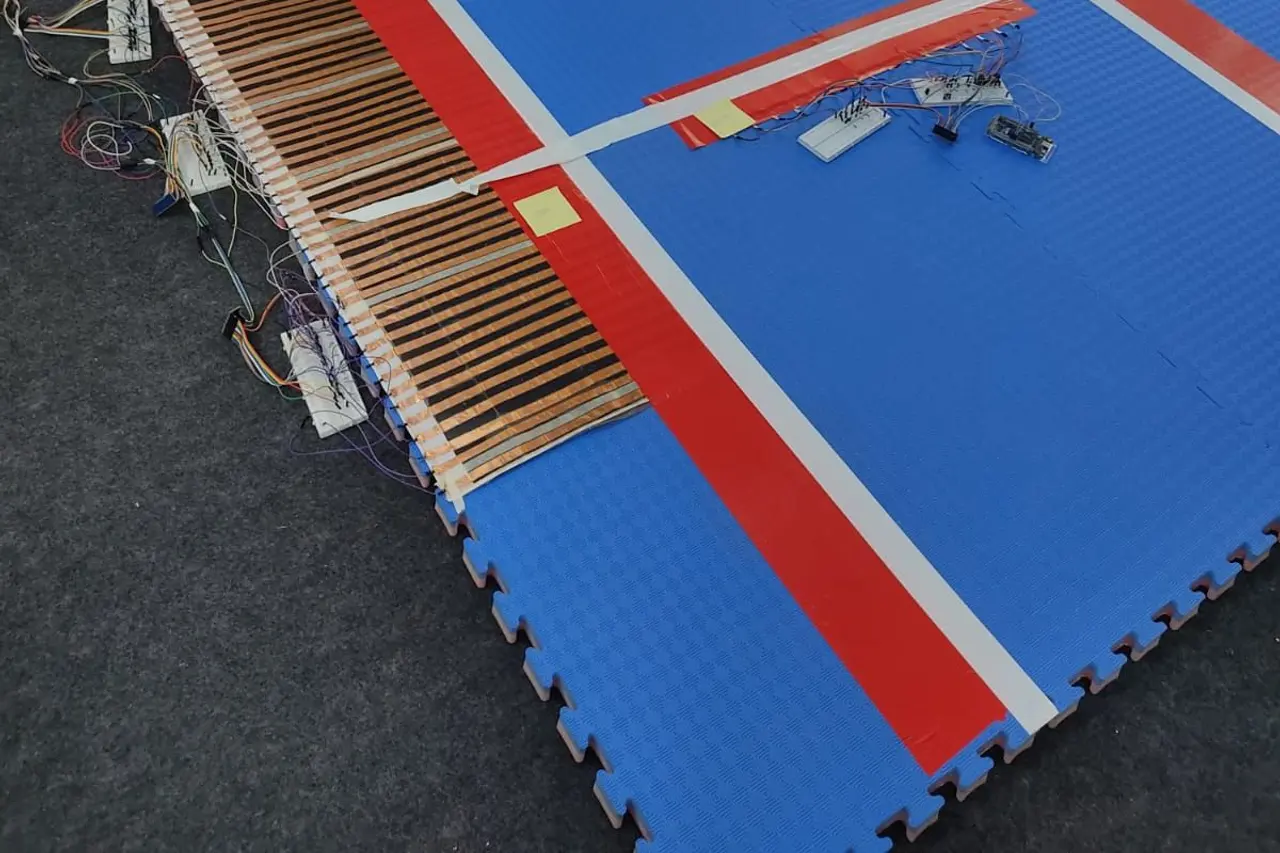
The category is piezoresistive film — apply pressure to it, and its resistance drops in proportion to the force applied. Wire a grid of electrodes above and below a sheet of it, and you get a two-dimensional map of pressure across the whole surface — without a single camera, without needing line of sight, and without caring about stadium lighting. (The specific material and construction we use is part of what we’re not publishing yet — the underlying approach is what matters here.)
Why a grid, not a single sensor
A single pressure sensor can tell you that something touched down. A grid tells you where, how hard, and for how long — which is what you actually need to resolve a raid-line boundary call or a wrestling-mat edge case. Each tile in our matrix is 256 sensing nodes, enough spatial resolution to start distinguishing a full foot strike from a graze — we’re targeting centimeter-scale precision here, and that’s still working its way through validation.
Why it lives under the surface, not on it
The sensor layer sits beneath a protective stack we’re designing to stay thin enough that players don’t notice a change underfoot, while surviving the kind of impact a competitive raid actually produces. Long-run durability isn’t a number we’re willing to quote yet — it’s still in testing — so for now the plan leans on field-replaceable tiles and pre-match auto-calibration rather than a wear-cycle claim.
What this buys us over cameras
No calibration against changing stadium lighting. No occlusion when seven defenders pile on top of a raider. No expensive multi-camera rig and video-review delay. The tradeoff is that this approach only tells you about contact with the surface — which is exactly the signal a boundary call needs.
More on the edge-processing side of this — how we get from a pressure reading to a referee’s device — in the next post.