March 25, 2026 · Vyanika Team
Engineering Toward Sub-50ms Latency at the Edge
Fifty milliseconds sounds small until you try to build a distributed system that reliably hits it under real match conditions. Here’s how the pipeline is structured, and an honest look at where the number stands right now: it’s a design budget, not yet a measured result on hardware.
Budgeting the pipeline
The flow runs in four conceptual stages:
- Footfall — the sensing matrix registers a pressure change at the contact point.
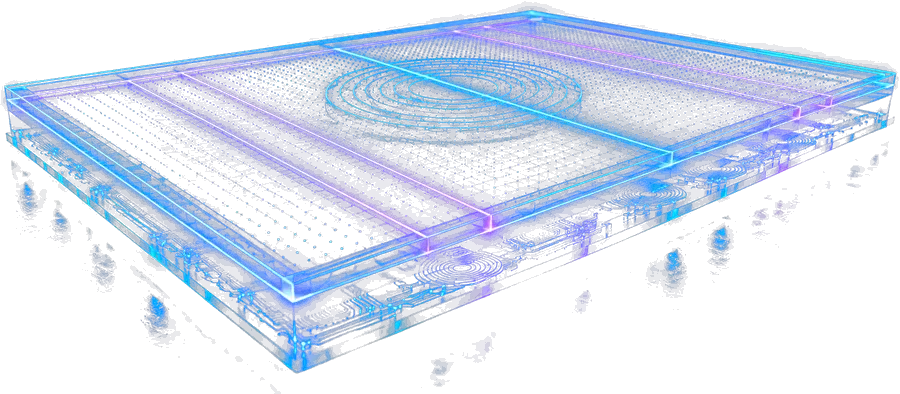
- Local Sensing — the sensor grid around the contact zone is read and filtered on-tile.
- Edge Decision — on-mat hardware resolves the call locally.
- Device Sync — the call reaches the referee’s device, the ringside tablet, and the broadcast feed together.
We’re deliberately not publishing a per-stage millisecond breakdown here. We only have one number we actually trust: the end-to-end engineering budget, currently estimated around 43ms worst-case against a 50ms target — about 8ms of margin. Slicing that into four confident-looking per-stage numbers would be more precise than what we’ve actually validated.
Why the decision happens on the mat, not in the cloud
A round-trip to any cloud service — even a fast one — adds network latency that varies with venue connectivity, which is exactly the kind of variance a live officiating system cannot tolerate. So the actual line-breach decision is designed to be resolved entirely by hardware embedded at the venue, not by a server somewhere else.
Fan-out, not round-trip
Once a decision is made, the design pushes it simultaneously to every connected device: the referee’s wearable, a ringside official’s tablet, and (in broadcast deployments) the production feed. That fan-out, rather than a request/response model, is what should let every stakeholder see the same call at effectively the same instant.
Why this matters more than raw accuracy
A system that’s accurate but slow still loses to a human referee’s instinct to make the call in real time — nobody waits three seconds for a video review mid-raid. Hitting our latency target would mean the system operates inside the same real-time window a human referee does, just with sensor-grade precision instead of eyesight. We’ll publish the measured number, not just the budget, once on-hardware validation is done.